Social media has changed the way in which audiences interact with and consume television. No longer do people simply sit down to enjoy an episode of their favourite show but often also engage in further consumption of it either during or after the show has ended. Audiences take to social media platforms to share their thoughts and create memes or GIFs of the show, which in some cases, they are still ‘watching’. Social media offers fans a way to interact with one another as the show happens, creating a new and virtual watching environment. This way of ‘watching’ has become vital to the success of the case study for this essay RuPaul’s Drag Race (2009-) (RPDRUS). This essay will explore the ways in which social media has changed the behaviour of Drag Race (DR) and how it has shaped its fandom. By using audience studies theories, this essay will further investigate the commodification of the show and how the production of the show manipulates the audience into believing they are part of a community through social media platform Twitter.
Audience studies as a field of film studies often becomes incorporated with other theoretical frameworks such as Spectatorship Theory and Reception Theory. However, as Doughty and Etherington-Wright argue, “these approaches do not actually study the audience” (Doughty and Etherington-Wright, 2018. p.199). In the chapter on audience research and reception, Doughty and Etherington-Wright outline key methodologies for conducting audience studies research. Firstly, they highlight three forms of data collection: empirical, qualitative, and quantitative (ibid). They continue to form four preliminary areas in which audience research and response must begin- “Who, Where, How and Why” (ibid, p.200). ‘Who’ pertains itself with the demographic of the audience – race, gender, sexuality, class (ibid). ‘Where’ is a question of exhibition – is the audience in a commercial setting such as cinemas or are they in a domestic setting such as at home in front of the television? (ibid, p.201). ‘How’ is in relation to the audience behaviours and societal expectations such as being quiet in the cinema or being able to pause a show whilst at home (ibid, p.202-203). Finally, ‘Why’ is the reasoning behind the audience making the choice to watch a certain film or television show and what influenced that decision such as word of mouth, marketing, star, genre etc (ibid, p.200-201).
Hirzalla and Zoonen note that historically, critical audience scholars claimed, “the only way to really “know” the audience was through ethnographic research which would enable the observation, analysis and understanding” (Hirzalla and Zoonen, 2017. p.3). However, with the rise of social media, there is no need for an audience researcher to engage in a more obtrusive method of gathering data and they can instead observe audience behaviours on social media. D’heer and Verdegem poignantly state that “via Twitter, audience members engage in virtual, public spaces without transcending the physical boundaries of the living room … This raises questions concerning the strategies and methods we should apply to assess the act of audiencing” (D’heer and Verdegem, 2014. p.224). Twitter allows for users to create content and shift the practice of being an audience. Hirzalla and Zoonen go on to say that “data can be collected from all public occasions where people express their responses to media content. In previous times these would be … letters to the editor, fan mail or meet-and-greets … currently this involves scraping data from all the internet sites and social media” and that “during television’s prime time in the evening, most Twitter traffic appears to be about television, thus producing a mass of unobtrusive data about viewing behavior” (Hirzalla and Zoonen, 2017. p.7).
Nevertheless, as Hirzalla and Zoonen point out, this data can be quantity over quality which can misalign the results. It would not be unexpected for more tweets to be negative than positive, and some tweets would use a trending hashtag for unrelated content to the show which can cause a negative impact on the quality of data in an audience study. Although there are limitations to studying audiences via social media, there are considerable benefits such as accessibility, objectivity, and lack of direct influence from the audience researcher.
RDPRUS launched in 2009 on the cable network Logo TV. Since its inception, there have been a further thirteen iterations of the original show based in different geographies such as: Canada (2020-), Chile (2015-2018), Thailand (2018-) and the UK (2019-). In 2021, World of Wonder (the production company behind RDPR) announced there would be a new version of the show to air on the BBC – UK versus the World (2022-). This season would bring together queens from a selection of the regional versions of the show and have them compete against each other. Although the format of the show drew from well-loved shows such as America’s Next Top Model (2003-2018) and Project Runway (2004-), RPDRUS incorporated a “drag ball aesthetic” (Brown, 2018. p.63) – propelling a subculture into the mainstream. In their essay on DR, Zeena Feldman and Jamie Hakim argue that “RPDR has facilitated drag culture’s move from the fringes to the mainstream, and contributed to drag’s celebrification” (2020. p.2). They continue to outline ‘celebrification’ as “professionalised, commercially-viable, brand-oriented and mainstream” (ibid. p.3). To consider drag’s ‘celebrification’ it is vital to look at the figurehead of this drag revolution.
According to Celebrity Net Worth, “RuPaul is an American actor, drag queen, model, author, and recording artist who has a net worth of $60 million. He is widely considered to be the most commercially successful drag queen in the United States” (Celebrity Net Worth, 2020). The ‘celebrification’ of drag is linked to the celebrification of RuPaul and his success. Of the twenty-four Primetime Emmy Awards RPDRUS has won, six have been awarded to RuPaul specifically for hosting. RuPaul’s success is also linked to financial security. In an interview with Marketplace in 2018, RuPaul says “I’m the most famous drag queen in the world; I’m the most famous drag queen ever in the history of humans on this planet” and when questioned on why he is rarely seen in drag he responds, “If somebody’s ready to throw down some serious cash, I am there” (Ryssdal, 2018). He can choose when he is in drag and when he is not based on the fee someone is willing to pay when most of the participants on DR and its audience do not have such a choice. In 2019, the median net worth of US households was $121,700 (Schwahn, 2021) and the median annual salary was just above $34,000 (Kopestinsky, 2022) – both of which are incredibly low in comparison to RuPaul’s estimated net worth. In 2018 it was reported that at World of Wonder’s bicoastal DragCon, $8million worth of merchandise was sold alone (Montero, 2018) – this excludes ticket prices, panel prices, meet and greets or general spending (such as food, drink, travel). Thus, RuPaul’s celebrification of drag and drag queens has turned them into a commodity with monetary value and a big factor in this is social media and audience engagement.
In the article “The RuPaul Effect…,” Jorge Sandoval states that “spread of images and videos from the show and its performers has created the illusion of ordinariness, an illusory normality symptomatic of the need for online users to theatricalize the ambit of the everyday” (Sandoval, 2018. p. 102). Here, Sandoval is pointing out the clear relation between the rise of social media and the success of participatory reality competition TV shows. Social media does not actively show the cost of looking like these drag queens nor does the show highlight how expensive it can be to compete in. Yvie Oddly – winner of RPDRUS season 11 and was criticised for her outfits on the show – claimed “she spent $14,000 on her famously “cheap”-looking wardrobe” (Miller, 2021). This quote from a winner of RPDRUS demonstrates the unachievable standards that RuPaul and DR sets and this expectation is perpetuated through DR and its queen’s social media channels. As Sandoval notes “Social media has added to our everyday life this urge to know what others are doing and at the same time, we can’t wait to tell the world what we are doing” (Sandoval, 2018. p.108) – this includes interacting with DR and the competitors long after the show has aired. Even the contestants themselves build their career further by continuing their presence through social media platforms – either by commenting on recent seasons of DR, participating in livestreams with other contestants or simply by keeping their social media channels up to date.
As of March 2022, the official RDPR accounts have over one hundred million followers combined, highlighting their audience outside episodes of DR airing. The vast scope of the RPDR accounts online shows that social media can be a useful tool for audience studies researchers – specifically with the popularity of hashtags used by audiences to live tweet reactions to a show as it airs. The most recent series of DR are RPDRUS season 14 and UK Versus…, both of which have been airing simultaneously in the UK and the US. When researching this essay, I searched for #dragrace and #dragraceuk respectively to see the engagement from its audience. Both hashtags are promoted by RuPaul with him saying #dragrace at the end of each introductory segment. RuPaul is breaking the fourth wall and telling the audience to participate in the show (although it is clearly pre-recorded and any tweets or participation from the audience will have little to no effect on the outcome of the show). From collating data on talkwalker.com (a data platform that collates tweet data from Twitter) the use of #dragraceuk increases significantly when the episode airs in the evening on February 22nd (figure 1). The same can be seen with #dragrace when RDPRUS airs on February 26th. The engagement of #dragraceuk increased by 800% and #dragrace by 500% whilst the respective episodes were on the air. The phenomenon of live tweeting compliments Sandoval’s notion about social media. Fans of DR prove their level of fan by joining in discussions, retweeting, and liking tweets from other fans and contestants of the show, whilst the show is still on their screens. Again, it is not possible to truly know the percentage of the audience’s attention that is given to social media and the percentage given to the show itself, yet the quantity of tweets, engagement and potential reach outlined in figures 1 and 2 proves that social media is just as part of being an audience as the physical act of watching. By using a data scraping tool, audience researchers would be able to answer part of the ‘who, where, how and why’ from Doughty and Etherington-Wright’s methodology. Demographics can be determined easily by scraping data from social media as seen in figure 3. In a few seconds, data can be collated and visualised from social media to demonstrate information about an audience. The ‘where’ becomes a little more complex to mark definitively by scraping data from social media, however, it can be assumed that most demographics are watching DR in a domestic setting and on a personal screen (television, laptop, tablet or mobile). What social media can shed light on specifically is the ‘why’ potion of this methodology.
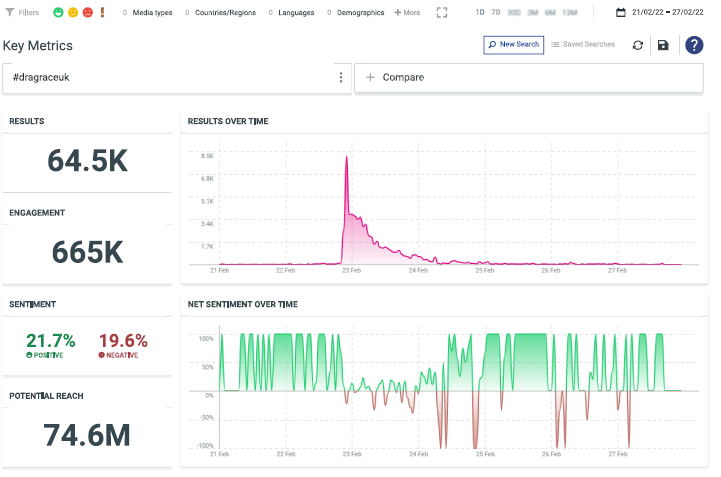
Figure 1: #dragraceuk results from 21.02.2022-27.02.22 collated on talkwalker.com
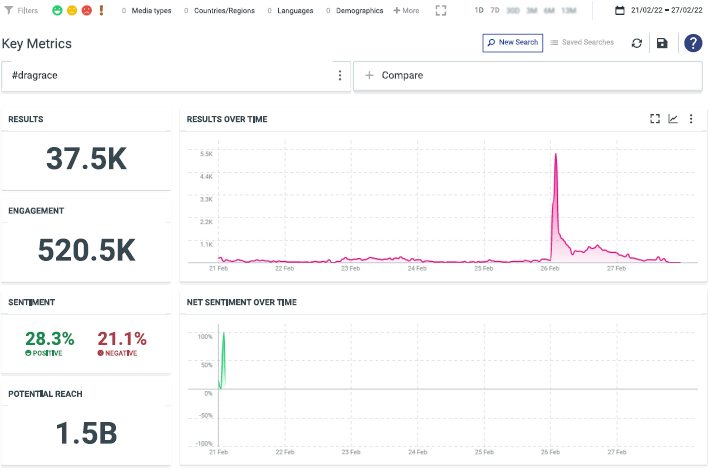
Figure 2: #dragrace results from 21.02.22-27.02.2022 collated on talkwalker.com
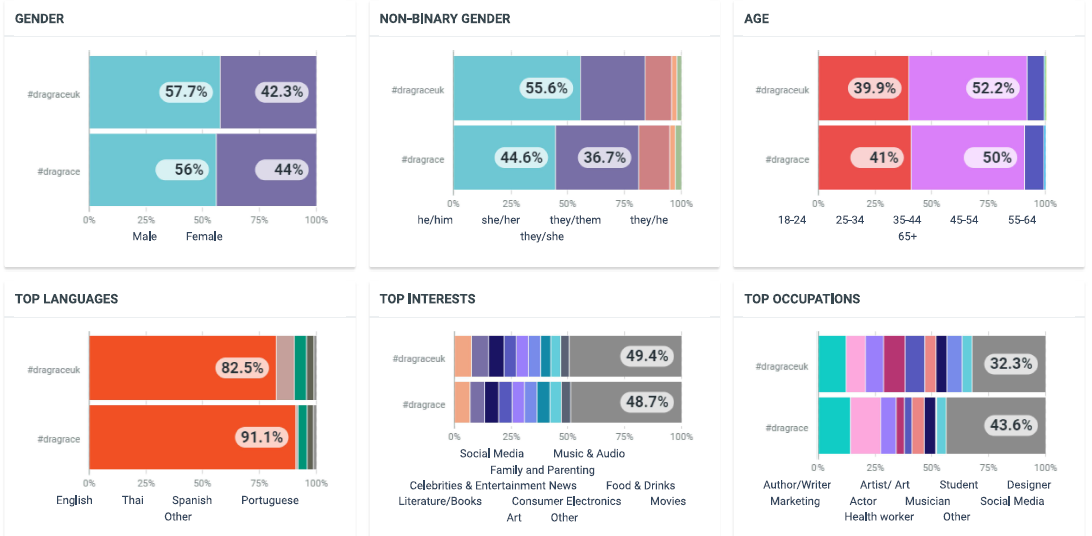
Figure 3: Comparison of demographics from Twitter users who tweeted #dragrace and #dragraceuk from 21.02.22-27.02.2022 collated on talkwalker.com
Feldman and Hakim discuss social media participation as a key factor in DR success. They state “RuPaul routinely directs viewers to ‘participate’ in Drag Race through a hashtag: #dragrace. In later seasons, audiences are also encouraged to express their support for their favourite finalist via hashtag. Here, social media platforms are positioned as proxies for community but they also work to enlarge RDPR’s cultural-cum-economic footprint” (Feldman and Hakim, 2020. p.16). The success in fans using the various hashtags to interact with each other proves that DR knows how to manipulate their audience into believing their participation is part of the show. Although RuPaul requests for audiences to tweet their support of finalists, he is always noticeably clear in stating “the final decision is mine to make.” However, the sense of community is strong enough between fans and the contestants on the show that often RuPaul’s final decision on the winner causes unrest and viewers take to social media to profess their love for another queen. This has happened in more recent seasons – a specific example is when Lawrence Chaney was crowned the winner of season 2 of RDPRUK instead of fan favourite Bimini Bon Boulash. Viewers took to social media to praise Lawrence but also claim “Bimini was robbed.” This reaction caused ripples across social media – so much so that it became headline news after the final episode aired and the hashtag #DefundTheBBC started trending on Twitter (Storey, 2021). What is most interesting about this reaction is that the news surrounding this outcry focuses solely on audience reactions on social media.
Although social media inherently encourages users to share their thoughts, feelings, and opinions constantly, DR manipulates its audience into thinking they have influence. The official social media accounts entice in viewers to comment of the episodes as if they are happening in real time. By interacting with viewers in this way, it maintains the idea of a community and that the audience has just as much power as the producers, which is not the case. As John Fiske argues in his chapter on popular culture:
the commodity-consumer approach puts the power with the producers of the commodity. It is they who make a profit out of its manufacture and sale, and the consumer who is exploited insofar as the price he or she pays is inflated beyond the material cost to include as much profit as the producer is able to make. (2003. p.112-113).
The producers of DR and RuPaul exploit the idea of community and family (RuPaul is often referred to as Mama Ru and he expresses to the queens that they are all his children – reminiscent of houses in ball culture) and by doing so creates the illusion of equality between the show and its audience. This illusion thus can have several impacts – negative and positive. DR endeavours to create a safe space for those competing and those watching but it also has created a culture in which fans can actively condemn other queens for their actions, wins or losses -as seen with Lawrence Chaney and Bimini Bon Boulash. What DR has mastered, shamelessly, is self-promotion and branding and they regularly feed this to their viewers online and through episodes. “Now available on iTunes” has become synonymous with RuPaul and DR by RuPaul saying this after a song is recorded on the show. Although tongue in cheek in the later seasons, this line is delivered with a serious intent of asking people to buy his music. By creating a sense of family and community, RuPaul asks the audience to spend money on DR products to support the community. By commodifying drag and DR it has a seeming positive impact on the LGBTQIA+ community whilst purposefully advancing World of Wonder revenues.
What RuPaul and DR are doing through the manipulation of social media and breaking the fourth wall during episodes is reinforcing the idea of community as a means of selling their product. Sandoval discusses this at length and interestingly notes that:
this reality-type show is presented as entertainment, … claims to help the LGBTQ community to be more visible, and to promote tolerance among viewers outside this community; however, the show presents a distorted view of a community where it appears that everybody does staged drag. This inaccurate view of a community is presented in an environment where the main goal seems to be to sell an image as a product, along with more conventional products such as videos, books, and songs; a TV program with strong and obvious commercial elements such as product placement. (Sandoval, 2018. p.103).
This accurately highlights the falsification of the drag community and by extent its representation of drag. This further complicates its interaction with the audience as it could be said that what DR is showing them is a lie. Although this is an extreme interpretation, audiences have taken to social media to question the structure of the show and with contestants who have come across negatively subsequently ‘blaming it on the edit.’ This accusation has been brought up so often by fans and contestants that editor for RPDRUS Jamie Martin spoke out against these claims (Morris, 2020) and RuPaul released a single called “Blame it on the Edit” in late 2021, seemingly aimed at contestants who are taken this stance after appearing on the show (James, 2021). This response demonstrates the power of social media. Without social media these claims would likely not have been heard by the production company or RuPaul. Previously people may have written to World of Wonder directly or complained to broadcasting officials yet now they can comment their dismay instantly and continuously until they get a response. It could also be argued that DR adopts a hypodermic needle model (where in which the audience accepts a specific message without question from the producer of the media) to construct its audience. Fans are expected to trust RuPaul and his representation of drag and this trust is implemented by RuPaul asking for the audience to interact with the show. This plays into the falsified idea of community that DR perpetuates throughout its franchise and across its social media. This confirms that social media has changed viewing habits and influenced the lifespan of a particular episode – displaying the ‘why’ of Doughty and Etherington-Wright’s methodology.
Scraping social media data can confirm that viewers and fans are discussing the show and interacting with one another, however it does not account for multiple tweets from the same user or tweets using the hashtag to gain exposure because it is trending. Still, not using social media to study audiences would disregard an accessible and lucrative data set. Traditional methods of audience studies are still beneficial in the social media age, yet they need to be adapted to incorporate scraping and analysis of social media. When conducting research for this essay, it was not possible to execute interviews or surveys directly with viewers or fans of the show due to time constraints and ethical approval. Nevertheless, it would be a useful technique to gather more definitive and conclusive data on audiences than simply by scraping social media alone. This is because “tweets remain snapshots when linked to the individual users … we do not take into account what they share on other platforms, not to mention, in an offline context” (D’heer and Verdegem, 2014. p.224) and that when viewing social media, audience researchers must “use an analytic method that does justice to the premise that media texts have no singular meaning but that their meanings come into being through the interpretative processes of audiences or users.” (Hirzalla and Zoonen, 2017. p.10). A disadvantage of social media is that when tweets are posted, they are completely open to interpretation by the one reading them. The intent behind the initial tweet can become lost instantly and the perceived tone or meaning of the tweet by other users can become the ‘true’ meaning. This can skew audience research data by taking tweets at face value and not being able to fully explore the meaning behind a tweet with its creator.
Throughout this essay, it has become clear that traditional audience studies methodologies must work in tandem with social media analysis to be able to understand contemporary audiences. The advent of social media allows audiences to adopt their watching methods to interact and comment on the show in real time. It also extends the lifespan of individual episodes as audiences react to them in real time. It was not possible to fully investigate other social media platforms in this essay, however the same structure and effect on the audience would be expected to become apparent. Traditional audience research methods can be added to analysis of data scraped from social media. By using DR as a case study and Twitter as the core data set, it is apparent through the audience analysis that DR actively encourages audience participation, leading to a false and inflated sense of community and family. By promoting #dragrace on the show, RuPaul suggests that he values the audience’s opinion and invites them to become a part of the discussion when actually the audience have minimal influence over the construction of the show. But, the interactive social element of the show is integral to its success and thus leads to financial success with the support of its audiences.
Bibliography
Brown, A. (2018). Being and performance in RuPaul’s Drag Race. Critical Quarterly, 60(4), pp.62–73.
Celebrity Net Worth. (2020). RuPaul Net Worth. [online] Available at: https://www.celebritynetworth.com/richest-celebrities/ru-paul-net-worth/.
D’heer, E. and Verdegem, P. (2014). What social media data mean for audience studies: a multidimensional investigation of Twitter use during a current affairs TV programme. Information, Communication & Society, 18(2), pp.221–234.
Doughty, R. and Etherington-Wright, C. (2018). Understanding film theory. London: Macmillan Education.
Feldman, Z. and Hakim, J. (2020). From Paris is Burning to #dragrace: social media and the celebrification of drag culture. Celebrity Studies, 11(4), pp.1–16. Page range in journal: 386-401.
Fiske, J. (2003). Understanding Popular Culture. In: W. Brooker and D. Jermyn, eds., The Audience Studies Reader. London: Routledge, pp.112–116.
Hirzalla, F. and Zoonen, L. (2017). Media Effects: Methods of Critical Audience Studies. The International Encyclopedia of Media Effects, pp.1–13.
James, M. (2021). RuPaul’s new song “Blame It on the Edit” takes aim at Drag Race contestants. [online] QNews. Available at: https://qnews.com.au/rupauls-new-song-blame-it-on-the-edit-takes-aim-at-drag-race-contestants/ [Accessed 6 Mar. 2022].
Kopestinsky, A. (2022). What Is the Average American Income in 2021? – PolicyAdvice. [online] PolicyAdvice. Available at: https://policyadvice.net/insurance/insights/average-american-income.
Miller, R. (2021). Shantay, You Pay: Inside the Heavy Financial Burden of Going On “Drag Race.” [online] http://www.vice.com. Available at: https://www.vice.com/en/article/y3dmav/what-does-it-cost-to-go-on-rupauls-drag-race.
Montero, R. (2018). How This Production Company Created Its Very Own World Of Wonder. [online] Forbes. Available at: https://www.forbes.com/sites/roytelmontero/2018/12/07/how-this-small-production-company-created-its-very-own-world-of-wonder/?sh=175012fc368c [Accessed 6 Mar. 2022].
Morris, L. (2020). RuPaul’s Drag Race editor speaks out on backlash to storylines. [online] Radio Times. Available at: https://www.radiotimes.com/tv/entertainment/reality-tv/rupauls-drag-race-editing/ [Accessed 6 Mar. 2022].
Ryssdal, K. (2018). For RuPaul, “drag is a miracle.” [online] Marketplace. Available at: https://www.marketplace.org/2018/10/23/business/corner-office/rupaul-interview/ [Accessed 7 Mar. 2022].
Sandoval, J. (2018). The RuPaul Effect: The Exploration of the Costuming Rituals of Drag Culture in Social Media and the Theatrical Performativity of the Male Body in the Ambit of the Everyday. Theatre Symposium, 26(1), pp.100–117.
Schwahn, L. (2021). The Average Net Worth by Age: How Does Yours Compare? [online] NerdWallet. Available at: https://www.nerdwallet.com/article/finance/average-net-worth-by-age.
Statista Research Department (2022). Social media use while watching TV by age in the UK 2020. [online] Statista. Available at: https://www.statista.com/statistics/1127225/social-media-use-while-watching-tv-uk-age-group/.
Storey, K. (2021). RuPaul’s Drag Race UK fans think Bimini Bon Boulash was robbed of crown. [online] Metro. Available at: https://metro.co.uk/2021/03/18/rupauls-drag-race-uk-fans-think-bimini-bon-boulash-robbed-of-crown-14269240/ [Accessed 9 Mar. 2022].
Filmography
RuPaul’s Drag Race. (2009-). Developed by RuPaul and World of Wonder. [Online]. USA: Logo TV & VH1. Available from Netflix UK and WOWPresentsPlus.
Canada’s Drag Race. (2020-). Developed by RuPaul and World of Wonder. [Online]. Canada: Crave. Available from BBC iPlayer.
The Switch Drag Race. (2015-2018). Developed by RuPaul and World of Wonder. [Online]. Chile: Mega. Available from WOWPresentsPlus
Drag Race Thailand. (2019-). Developed by RuPaul and World of Wonder. [Online]. Thailand: LINE TV. Available from WoWPresentsPlus
RuPaul’s Drag Race: UK VS the World. (2022-). Developed by RuPaul and World of Wonder. [Online]. UK: BBC. Available from BBC iPlayer.
America’s Next Top Model. (2003-2018). Developed by Tyra Banks, Ken Mok and Kenya Barris. [Online]. USA: UPN, The CW & VH1. Available from Amazon Prime Video.
Project Runway. (2004-). Created by Eli Holzman. [Online]. USA: Bravo & Lifetime. Available from Amazon Prime Video.
 THE HNS
Leave a comment