
Japanese documentary filmmaker Kazuhiro Soda’s latest observational film The Cats of Gokogu Shrine captures life in the quiet coastal town of Ushimado. With an aging population and a prevalent but decreasing cat community, Soda’s documentary feels like a unique slice of life that will never be able to be captured again. It is beautiful and slow – reflective of life in Ushimado – and is completely captivating.
Soda has ten commandments he follows when creating a documentary – no research, no predetermined interviews, no staged shots – and the result is a blissful and interesting insight into life in this town. The cats that have moved into Gokogu Shrine are a source of conflict in Ushimado – half the residents seem to love them, half seem to hate them. Yet it seems that they cannot exist without each other. In a Q&A at the BFI London Film Festival, Soda said that cats had become a taboo subject, and this anxiety is clearly seen in some of the scenes throughout the documentary. When asked what he thinks about the cat, one resident is very hesitant and anxious to provide his answer, unsure what the right or wrong thing to say is. It seems like a silly thing to be a taboo subject to the community, but that cats are a financial and physical burden – so much so that they have implemented a neutering scheme to ensure that adult cats are captured and neutered to prevent from the population increasing. This seems like a dramatic response to a few cats but they have taken over the shrine in a way that is interrupting the natural order of things. However, many people travel to see the cats – showing the positive impact they have on humans – with one woman traveling to see the cats every few months because she works, gets stressed, heals (by visiting the cats), and then repeats the cycle again. In a world where everything can be monetised, it seems silly to not let them turn into a tourist attraction, but this would disturb the towns tranquillity.
The cats are obviously a big focus of this documentary, they are full of character and are very very cute. None of this is surprising, of course cats are cute, but the way Soda captures them shows off their playful behaviour, their self sufficient (but at times needy) nature, their feistiness, and how they navigate life amongst humans. Never did I think seeing so many cat bogeys would be so charming, but that is exactly what is so wonderful about this documentary. Cat boogers and cat poop are a regular topic of conversation, they are problems that need to be somehow solved. However as Soda said in the same Q&A, this documentary also portrays the initiatives to clean up the streets of Japan – there is “no room for anything uncontrollable or irregular” says Soda, and that unfortunately also extends to the cats of Gokogu Shrine.
He filmed for around two years and the cat population was around 40 and as of today there are only around 10 cats left. It feels sad to realise that these cats are purposefully being eradicated through purposeful neutering. That said, the residents do care for them, volunteers feed them, make sure they are healthy and happy, but it still feels as though humans are interfering with nature in some way. Perhaps it is because Soda’s documentary style is so observant that we just watch life unfold and by restricting the cat population it feels more unsettling.
That said, the sense of community in Ushimado is beautiful. There is a connection to the land and tradition that we don’t often see in the modern world. Everyone volunteers to look after the cats, to work on the gardens, clean up, restore the Shrine, and repair damage after a typhoon. Everyone is interested in each other and the wellbeing of the town. Again, Soda allows these activities to just happen, he is not instructing the people of the town to behave in a certain way – although there is the argument in film that cinéma vérité (an observational style of documentary filmmaking from the 1960s that champions authenticity and a lack of manipulation) can never truly be authentic because people always behave differently in front of a camera, but I’m not here to debate the parameters of cinéma vérité – and this feels like we have inserted ourselves into the community, becoming a piece of the furniture just like the cats themselves.
The Cats of Gokogu Shrine portrays the joy in the mundane and beauty in the everyday. People have stories to tell, cats have kittens to feed, retirees have fish to catch. There is serenity to be found in letting life unfold, especially if you’re surrounded by cats.
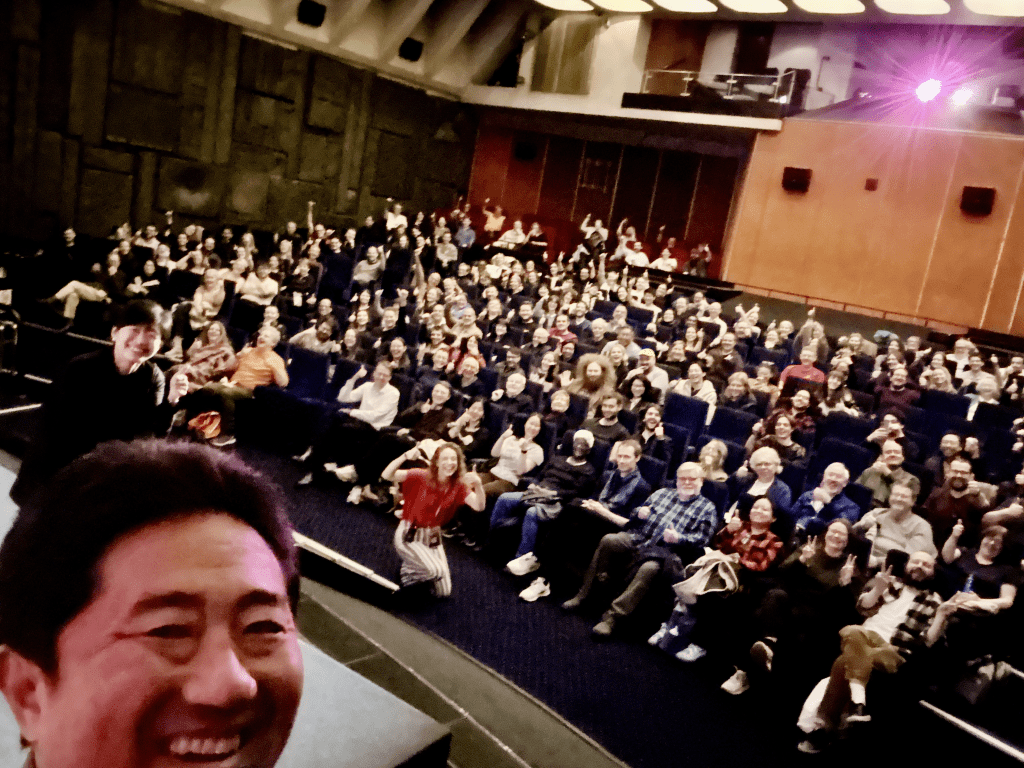
Also, I can’t resist including this selfie Soda did with the audience at this screening, see if you can find me:
 THE HNS
Leave a comment