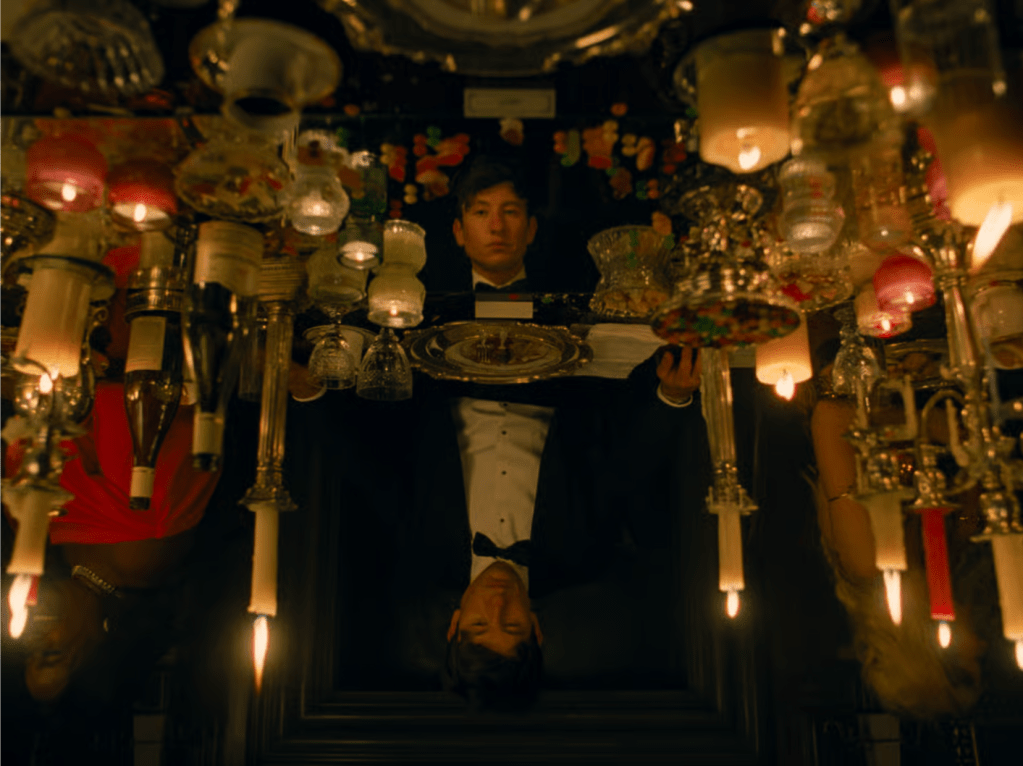
NOTE: Originally commissioned for an academic edited collection, this chapter forms part of my wider research into millennials as audiences and pop culture. While it was not included in the final publication, I am sharing it here to contribute to ongoing conversations in this space. This work has not been formally peer reviewed.
This Modern Love Breaks Me: Millennial Nostalgia, Manipulation, and the Unreliable Scorer in Saltburn (Fennell, 2023)
With an average release year of 2005, the soundtrack of Saltburn (Fennell, 2023) is more than just a sonic backdrop — it is a strategic emotional framework. Set in 2006, nostalgia serves not only as an aesthetic device but also to shape and control the narrative unfolding. It is most successful at this through its soundtrack of 2000s songs, aimed particularly at millennial audiences. Born between 1981 and 1996 (Dimock 2019), millennials are invited into Saltburn’s nostalgic haze as the soundtrack works to create an immersive sense of retrospective longing, seducing millennials into the world of Saltburn that weaponises the emotional resonance of formative cultural memory. This chapter will argue that whilst director Emerald Fennell used sonic “anchor points” (Cremona and Moss 2024) during her writing process, it is Oliver Quick (Barry Keoghan) who is positioned as the playlist curator, manipulating the millennial audience by choosing intentional 2000s songs to evoke his desired reading of a ‘memory’.
Music is a powerful tool in cinema, capable of having a profound effect on the spectator. Jessica Green states, “the calculated use of film music in conjunction with the other channels of information helps to create the narrative and control the way that the audience interprets a film” (2010, 82). Furthermore, she outlines that conveying emotion and suggesting connections or themes are the fundamental functions of music in film (ibid., 82-82) and that it can be successful in both identifying and suspending reality (ibid., 84). Claudia Gorbman takes this further in her book ‘Unheard Melodies: Narrative Film Music’, by claiming that music “functions to lull the spectator into being an untroublesome viewing subject” (1987, 56). Hilary Lapedis also analyses the use of pop music in cinema and argues that
“Pop music’s function […] is essentially two-fold. First, it reaches the spectator immediately and in a language that is so codified as to predict effect. It works both on the individual with their own responses to those codes and on the collective audience, drawing upon mediated representations of the song. Second, pop music functions as anchorage to the scene, offering a pre-ferred reading of the event” (1999: 378).
By looking at data from music streaming platform Spotify, economist Seth Stephens-Davidowitz discovered that older “songs […] are now […] most popular among men who were 14 when they were first released” (2021). He found that “the most important period for men in forming their adult tastes were the ages 13 to 16” (ibid) and women “on average, their favorite songs came out when they were 13. The most important period […] were […] ages 11 to 14” (ibid). These are the foundations on which Saltburn operates in its seduction of millennials.
The soundtrack comprises 15 songs from a diverse range of genres, capturing the full scope of the UK’s 2000s oeuvre. These general signifiers effectively allow the audience to experience Saltburn through Oliver’s perspective, aligning them with him as the protagonist and narrator while creating a sense of commonality through music. For example, ‘Have a Cheeky Christmas’ by The Cheeky Girls (released in 2003) is used expertly during the Christmas party scene to represent a fun and frivolous party that Oliver is not privy to. Another two examples are ‘Perfect (Exceeder)’ by Mason & Princess Superstar (released in 2007) and ‘Loneliness’ by Tomcraft (released in 2002). Although released five years apart, they are closely linked in the collective memory of this era and become sonic representations of Oliver’s emotional state and experience with the Cattons.
By exploring the diegetic (“produced within the implied world of the film” (Kassabian 2001, 42)) and nondiegetic (“music that accompanies a scene but is external to the fictional world” (Tan, Spackman, and Wakefield 2017, 605)) soundtrack, this chapter will argue that Saltburn weaponises songs of the 2000s by evoking nostalgia in millennials to accept Oliver’s depiction of events. This chapter posits that Saltburn’s soundtrack does more than evoke a sense of time and place; it acts as a strategic tool of manipulation, purposefully aligning the spectator emotionally with Oliver’s perspective through a nostalgic lens that is heightened through deliberate song choices. Oliver is Saltburn’s unreliable narrator – a narrator who “misleads readers, either deliberately or unwittingly […] withholds key information from readers […] [and] may deliberately lie or misdirect” (Seddon 2020). However, he is also positioned as the retrospective author of the film’s sonic landscape, the soundtrack becomes a curated act of self-mythologising, transforming him into the unreliable scorer — one that disarms the audience’s critical distance and reframes narrative violence as emotional authenticity. In doing so, Saltburn reveals the extent to which nostalgia can be deployed to distort and control the viewing experience. Nostalgia becomes Oliver’s weapon, creating a seductive atmosphere of youthful hedonism that shapes characterisation and manipulates audience sentiment under the guise of nostalgia. In doing so, the spectator becomes complicit in the manipulation and destruction of the Catton family, rendering them the ultimate untroublesome spectator.
To fully explore the concept of nostalgia and how Oliver weaponises popular music to create a complicit spectator, this chapter will analyse three of the songs featured on Oliver’s deadly playlist: ‘This Modern Love’ by Bloc Party, ‘Time to Pretend’ by MGMT, and ‘Murder on the Dancefloor’ by Sophie Ellis Bexter. These songs have been selected with three key criteria in mind:
- Their placement at key narrative turning points.
- Their strong resonance with millennial audiences and the 2000s time period.
- Their ability to function diegetically, non-diegetically, or somewhere in between – evoking reflection on memory, emotion, and the effect this has on millennial audiences.
By focusing on these songs in particular, the case studies will further argue that Oliver manipulates the audience into siding with him by disarming their objectivity through a nostalgic soundtrack. It will explore and analyse how these songs relate to Saltburn as a whole, investigating how these ‘anchor points’ operate not just as nostalgic cues, but as a tool of narrative and character construction and understanding. The soundtrack excels in ironic destabilisation, championing Oliver’s deadly obsession with Felix (Jacob Elordi) through the comforting rose-tinted lens of nostalgia by engaging with millennials’ sensibilities. It will argue that the soundtrack’s success is due to its obviousness, not despite it, going beyond surface-level nostalgia by leveraging the ability to evoke memories of the past through sonic design, allowing for a multifaceted and destabilised viewing experience that results in Oliver being triumphant and celebrated by the audience.
Nostalgia is a complex emotion. Originally thought of as a life-threatening disease by Swiss physician Johannes Hofer in 1688 (Arnold-Forster, 2024), the concept and emotion of nostalgia have since evolved. Tiffany Watt Smith observed “from deadly disease to health-giving pastime in less than a century: nostalgia ain’t what it used to be” (2015, 187) as she argues that feelings of nostalgia can have a positive effect on health and wellbeing. It is now recognised as a “bittersweet – albeit predominantly positive – and self-relevant emotion that rises from reflecting on fond and meaningful autobiographical memories” (Hepper et al. 2020, 8). It fosters a sense of comfort (Batcho, 2020; Walls, 2021), safety (Sedikides et al., 2019; Vaccaro et al., 2020), and is an emotion felt across lifetimes, cultures, and ethnicities (Hepper et al., 2012; Orr, 2017). Nostalgia is also highly social, placing the self within specific cultural events or eras, often surrounded by close friends or family (Zhou et al., 2012; Sedikides & Wildschut, 2019). Nevertheless, it can also cause feelings of forlornness or longing for simpler, easier, or happier times. As Krystine Irene Batcho surmises, “nostalgia entails pleasant feelings of happiness and comfort along with feelings of sadness, longing, and loss” (2020, 31). Batcho is showing the nuances that make nostalgia complex and sometimes difficult to understand.
One can also be nostalgic for a time that they did not experience. As Felipe De Brigard states in his essay, nostalgia does not have to be real memories (2020). However, it can be “a possible past one didn’t experience, a concurrent nonactualised present, or even idealised pasts one couldn’t have lived but nevertheless can easily imagine by piecing together memorial information” (ibid.). Since nostalgia can be “a kind of imagination” with a “motivation to reinstate in the present the properties of the simulated content that […] make us feel good” (ibid), Oliver is manipulating his memories to convey specific properties. However, as Batcho states, “one can remember without being nostalgic, but one cannot be nostalgic without remembering” (2007, 362). Oliver’s retelling takes place in 2022 rather than 2006, and his motivations towards the Catton family are withheld for most of the film. However, upon reflection, his desire to manipulate and conquer the Cattons and the millennial spectator becomes more overt when analysing his use of popular music, specifically concerning the present day he occupies.
The context of Saltburn is essential to consider to understand the impact the soundtrack would have on the millennial spectator. Released three years after the start of the global COVID-19 pandemic, a period in which scholars reported a “nostalgia bump” (Huang, Chang, and Landau 2023: 2), Saltburn is a tale told primarily in hindsight. Music was the most common nostalgia-inducing media consumed during the pandemic, followed by films and television (Wulf, Breuer, and Schmitt 2021), which makes Saltburn a tempting trip down memory lane for millennial audiences. Millennials are also deemed the unluckiest generation (Thompson 2013), are more likely to fall into economic despair than generations before them (Hobbes 2017), have less job security (ibid), are the most derided (Shrimpton and Clemence 2017), and became the burnout generation (Petersen 2019; Petersen 2021), meaning they are likely to be more susceptible to Saltburn’s nostalgic offerings. Specifically, as the world of Saltburn is:
- Post 9/11 but pre the invasion of Iraq (The Sunday Times 2009)
- Where social media is emergent but not dominating (see Hazael 2023)
- Before the economic crash of 2008 and the global recession that followed (The Sunday Times, 2009)
These three historical markers are significant in evoking nostalgia in Saltburn’s audiences. Dr Sarah Bishop says the 2000s “represents a time before the social media explosion, which can be particularly compelling as it indicates a simpler and more connected time” (Ross 2023). It is also important to note that Saltburn is set during Oliver’s university days, an easy signifier of youth and hedonism that is reinforced by the 2000s soundtrack. Psychologist Dr Sarah Bishop states that when thinking back to coming-of-age ‘school days’, as Oliver is in Saltburn, “we often think of shared experiences or a sense of belonging to a particular community or era […] It’s like a thread that weaves us into a tapestry of social connection, fostering deep fulfilment and strengthening our bonds with others” (Ross 2023). By manipulating millennial audiences through its soundtrack, Saltburn is weaponising a shared past to destabilise the viewing experience. One of the shared pasts that Saltburn evokes is ‘indie sleaze’. ‘Indie Sleaze’ is a term coined in 2021 to describe the indie music and fashion scene of the mid-2000s (Georgia, 2024), which represents the hedonistic youth of the 2000s, as exemplified by bands such as The Strokes, Yeah Yeah Yeahs, and The Libertines (ibid). In Rough Trade’s ‘A Rough Guide To: Indie Sleaze’, they also include the debut albums of Bloc Party and MGMT (ibid), which feature ‘This Modern Love’ and ‘Time to Pretend’.
Popular music is often used to destabilise the audience and change their reading of a film. Prime examples are ‘Stuck in the Middle with You’ in Reservoir Dogs (Tarantino, 1992) (see Kalinak 2010) or ‘Singin’ in the Rain’ in A Clockwork Orange (Kubrick, 1971). These are two songs that are used to score violent scenes, making them unsettling and destabilising to watch. The sonic cues convey levity, while the on-screen action is pure violence. However, popular music can also be used to convey characterisation and further the spectator’s understanding, such as ‘Lust for Life’ by Iggy Pop in the opening of Trainspotting (Boyle, 1996). ‘Lust for Life’ is used as a sonic cue to reveal to the audience who Mark Renton (Ewan McGregor) is within seconds, eliminating the need for explicit information, as the audience will fill in the gaps with their knowledge of ‘Lust for Life’. This phenomenon is best understood in Adrian Wootton and Jonathan Romney’s summation that “Every viewer comes to the cinema carrying his or her own jukebox ready loaded, waiting only for the film-maker to hit the right buttons” (2, 1995). The difference in Saltburn is that Oliver is positioning himself as the same as the audience – a millennial who grew up in the mid-2000s, surrounded by this music and the shared connotations and memories they evoke.
Music has been identified as one of the most potent triggers of nostalgia (Schulkind, Hennis, and Rubin, 1999; Wildschut et al., 2006; Barrett et al., 2010; Garrido and Davidson, 2019), making it a prime tool for manipulating and inducing ironic dissonance or destabilisation. In their 2010 study, Barrett et al. agreed with findings from Janata et al. (2007) and Wildschut et al. (2006) that “the source of music-evoked nostalgic experience to be the idiosyncratic as-sociations that people have formed between particular songs and events in their past” (401). By scoring specific scenes with non-diegetic songs from the 2000s, Fennell has allowed millennial audiences to apply their memories and feelings related to songs to what is happening on screen, distorting Oliver’s behaviour into something acceptable and hiding the fact that Saltburn is his memory of events. Oliver is not only manipulating the Cattons through his actions onscreen, but also the audience through diegetic and extradiegetic music. Through detailed iconography on screen and the soundtrack being used diegetically or otherwise, millennial audiences are easily able to recognise who these people are and what motivates them through shared experiences and a collective memory. This works in Saltburn’s (and Oliver’s) favour as “nostalgia is a phenomenon that is very relevant to people’s lives” (Routledge 2016, 8).
The tapestry of Saltburn is one of deceit, obsession, and desire; yet, the soundtrack and its anchor points prevent it from turning completely into a horror story, draping it in a comfort blanket made up of sonic cues. Further, Stephanie Harlow found that films and music were the top two ways Gen Z and millennials experience nostalgia (2023). She discovered that 55% of people surveyed listen to music to remind them of positive memories, 36% listen to escape from reality, and Gen Z and millennials use music as a form of escapism (ibid). Therefore, Saltburn’s choice in soundtrack plays into millennials’ desires to escape back to a simpler and more carefree time, tempting them into its twisted narrative world with promises of indie sleaze and hedonistic anthems post the start of the COVID-19 pandemic. Whilst discussing the return of ‘indie sleaze’, GQ’s Meaghan Garvey notes that millennials are experiencing:
“For the first time their youth culture repackaged for a generation whose standing in target market demographics has finally eclipsed their own. You might condense the essence of the indie sleaze revival as [a] millennial mid-life crisis […] wherein the recent past is sold to us as something new” (ibid).
VICE agrees, stating that “If you had a Tumblr, Myspace, or Flickr account, get ready for young people to start referring to your aesthetics as “retro” and asking, “what’s that?” every time you mention any trend or form of technology that has been defunct for more than a decade” (Blasdel and Rothbarth (2023)). They continue to describe ‘indie sleaze’ as “hazy memories of … MGMT and The Strokes” (ibid) and that “it’s hard to pinpoint exactly what the resurgence of “indie sleaze” is about” (ibid). The point here is that “indie sleaze” is a term that has been applied to this era in hindsight, a manipulation and repackaging of what was true. Saltburn and its purposeful soundtrack are not only tapping into this repackaging of youth, but masquerades as a shared cultural archive for millennials – a reminder of the past that should feel cruel and jarring, especially when positioned inside the dark and manipulative world that Oliver has created but instead is a comforting playlist of noughties hits.
However, a criticism of the film was that it is not historically accurate in some areas. The fashion worn by Elspeth (Rosamund Pike) is from a 2018 runway show. Meanwhile, the family is watching Superbad (Mottola, 2007) at home, and the song “Low” by Flo Rida, sung during the karaoke scene, was not released until October 2007 (Kowhai, 2024). Lane responds to this by saying the songs are “as close as possible, really, just to put you back in that space,” and that “If it had been a couple of years later, that would have been an absolute no.” (Nast 2024). The purpose is as long as “it’s evocative of the period”, then it still makes sense (ibid). This suggests that Oliver occupies the role of an unreliable narrator and scorer, relying on memory and nostalgia for his points of reference; it is not inconceivable that some details may be inaccurate. Additionally, as Anglada-Tort, Baker, and Müllensiefen (2018) found, inaccuracies can be present in auditory memories.
Music and memory are a focus of Garrido and Davidson (2019), who note that “Our daily lives are accompanied by a musical soundtrack that is sometimes of our own creation and sometimes not, with the key moments of our existence as humans being marked by music in striking ways.” (3). Music has a way to attach itself to significant memories by being encountered throughout everyday life and due to this “key life events can be emotionally heightened by the presence of music, ensuring that memories of the event become deeply encoded.” (ibid). The songs featured in Saltburn – diegetic or not – are likely to be attached to memories from this era. Whether Oliver purposefully listened to these songs is redundant, “just a few bars of a tune can be powerfully evocative of another time, another place, and the events and people associated with them” (ibid: 32) – meaning if they are synonymous with the time they can evoke nostalgia and resurface memories. The soundtrack has been championed as a quintessential list of mid-2000s hits (Nast, 2023). Saltburn music supervisor, Kirsten Lane, stated in an interview with GQ that songs were chosen by Fennell “very specifically […] They aren’t necessarily artists that are around now. But they meant something then.” (Nast 2023). Considering this, it is not surprising that when creating her “period piece” (King 2023), Fennel utilised songs that can work diegetically, non-diegetically, or a mix of the two, allowing millennial audiences to reflect on their associations and memories of a particular song and therefore allowing them to exert their influence onto the experience of Saltburn. Oliver has chosen these songs specifically to gain control of the narrative and force a preferred reading from his fellow millennials. The songs Oliver chose are not divisive, but they do appear to reflect what is happening on screen, creating emotional ambiguity and irony between what the audience sees and what they hear. This will be a key focus during the three case studies that follow.
Case Study 1: This Modern Love – Bloc Party (2005)
The use of ‘This Modern Love’ is a pivotal moment in Saltburn, both narratively and structurally. On the surface, this is a song about loss, longing, and heartbreak. Kele Okereke – singer of Bloc Party – describes the song as “two people on the telephone, who can’t touch each other, and as the song and the conversation progress, everything amplifies” (Singer 2005). Following an argument – that is not dissimilar to a lovers’ quarrel – Oliver goes to the local pub to find Felix has gone without him. The song begins as Oliver stares at Felix while he smokes and laughs with his friends. The line “this modern love, breaks me” plays right as Oliver turns back to look in the direction of the pub, arms up in the air, resting on his head, exhibiting being overwhelmed by emotion in the same way that Okereke sings it. It may seem dramatic and even performative, but young love and the heartbreak attached to it are powerful and all-consuming. As Garrido and Davidson argue, “personal memories become entangled with particular pieces of music to the extent that we can’t hear a particular piece of music without thinking of a certain person, a certain place or a certain event” (2019: 7-8). There is no evidence that Oliver ever listened to or even cared about this song in the diegetic world of Saltburn. Yet, it is used to articulate his emotional state in a way that feels too precise and accurate to question its inclusion here. ‘This Modern Love’ is a signifier of this being a memory, or more specifically, a memory refracted through fantasy and nostalgia. However, within the logic of Saltburn, it becomes more than just a signifier of heartbreak – it becomes affective dissonance and is used by Oliver to evoke sympathy.
The audience is not watching Oliver in the moment; they are watching Oliver remember the moment. A moment that, over time, has become embellished, curated, and scored with his own personal heartbreak anthem, as if he had curated a Spotify playlist that Stephens-Davidowitz could have analysed, to transport the audience to 2006. This song functions less as a realistic soundtrack and more as a retrospective playlist—a theme continued throughout the nondiegetic songs in Saltburn. ‘This Modern Love’ paints Oliver as the one heartbroken, the one excluded, the one Felix has betrayed, as the victim, rather than what he is – an obsessive, deadly stalker, infiltrating Felix’s life to destroy it. ‘This Modern Love’ makes the spectator feel sorry for Oliver. Serving as a reminder of heartbreak and loss, being left out or feeling at odds with the world around them. It evokes the bittersweet emotion Hepper et al. reference, whilst also aligning the situation with a recognisable experience that again aligns the millennial spectator with him.
Clay Routledge argues, for as much as nostalgia is about other people, is it “also about the self” (2016: 18). He says “When we engage in nostalgia we reflect on past experiences through the lens of the self. The experience is shared with others but recounted from our own vantage point. The memory is our own” (ibid). Due to its nostalgic appeal among millennial spectators, ‘This Modern Love’ enables millennials to project their sense of self and memories onto Oliver in the moment. Remembering and feeling a moment of heartbreak, recognising their relationship with the song and what that means to them. By doing this, it skews the reading of the scene and the true meaning of this song. For a moment, they are suspended in the belief that Oliver has been wronged. It acts as an effective smokescreen to excuse Oliver’s behaviour and his obsession, offering the audience a bonding moment (Lapedis 1999, 370) with Oliver when they should be pulling away from him, anchoring them in 2006 and on his side. Through this, ‘This Modern Love’ evolves from a melodramatic anthem of heartbreak into a love letter to obsession and delusion—a performance of heartbreak in which Oliver is the victim and Felix is the villain.
Case Study 2: Time to Pretend – MGMT (2005/2008)
‘Time to Pretend’ is strategically placed to convey success, hedonism, and the performativity of youth, serving a different purpose to ‘This Modern Love’. Although synonymous with the mid-late 2000s, some have criticised how on the nose the use of this song is in Saltburn (Ross 2023; Renshaw 2024). However, this is precisely why it works in manipulating the millennial audience into Oliver’s embellished retelling via nondiegetic sonic cues. Named as the second-best song of the 2000s by music magazine NME (2012), and ranked 12 in 2011 by them as the best songs of the past 15 years (Schiller 2011), it is not unrealistic to suggest that Oliver would choose that song as a symbol of the time to accompany his memory — just as ‘This Modern Love’ was used to convey heartbreak. Returning to Garrido and Davidson’s (2019) argument that music is encoded in memory, ‘Time to Pretend’ serves as an anchor point to recall youth and the perceived freedom that accompanies it. Played nondiegetically over a montage of Oliver’s ‘induction’ and ‘acceptance’ into the Saltburn inner circle, ‘Time to Pretend’ serves as a nostalgic callback, drawing on the millennial collective consciousness. If Oliver is the author of this soundtrack, he has chosen the ultimate ‘indie sleaze’ anthem to score his success. In doing so, it weaponises a collective memory of the mid-2000s’ reckless abandon, being young and beautiful, and attempts to sell Oliver’s ascension as natural, inevitable, and somewhat deserved. The song swells when Oliver enters the cornfield and is instructed to strip by Felix, his sister Venitia (Alison Oliver), and cousin Farleigh (Archie Madekwe) as they lounge in the blazing summer sun. On the surface, the lyrics the audience hears (“I’m feelin’ rough, I’m feelin’ raw, I’m in the prime of my life”) mirror the cornfield revelry that is being depicted on screen. However, the song’s inherent irony destabilises the montage’s visual excess.
Looking past the facade that Oliver is creating, it signals that this moment is not simply euphoric, but somewhat performative. Oliver is pretending to meet the requirements to fit in with the Cattons, and through his unreliable retelling, the use of ‘Time to Pretend’ suggests that maybe this is not the whole truth. Oliver is not experiencing a sense of belonging – he is performing it for his own sake and the audience. He is fated to pretend to belong in a space that will never truly be his, shadowing Farleigh’s continuous accusations throughout the film. Farleigh knows Oliver does not belong, whereas Venetia finds him “so real”. Interestingly, Farleigh is positioned as the outsider of the Catton clan by Oliver, when it seems as though Farleigh is the only one who truly sees him, despite his pretence. Farleigh even sadistically invites Oliver to sing ‘Rent’ by Pet Shop Boys (released 1987) at the family karaoke night in a bid to embarrass him and show him for who he is. It is only when Oliver realises the content of the song, singing the lines “you dress me up, I’m your puppet” and “I love you, you pay my rent”, that Oliver realises Farleigh’s motivations and decides to retaliate. This is an in-world example of music being weaponised; however, this time it is against Oliver with a much older song.
‘Time to Pretend’ signifies a turning point for Oliver; he is now inside Saltburn, manipulating the Cattons and the audience to achieve his ultimate goal. It represents the need and desire to fit in and be accepted, and in this scene, he is proving to the millennial audience that he does. By choosing ‘Time to Pretend’, he signals to the millennial audience that they share a common cultural consciousness. It reminds the spectator of how confusing youth can be. It also shows the apparent disparity between the Cattons and Oliver – they are perceived to be free in a way that Oliver is not, and this is key to the characterisation of Felix, Ventia, and Farleigh. They have everything, whether they want it or not, whereas Oliver must work for it, potentially never attaining it. On the surface, it symbolises triumph, acceptance, and belonging; yet, upon further review, it becomes clear that none of this is true – it is all a performance and an illusion.
Case Study 3: Murder on the Dancefloor – Sophie Ellis Bextor (2001)
While at first glance, the use of ‘Murder on the Dancefloor’ during Saltburn’s closing sequence might seem too literal (Snapes 2024), but within the logic of Saltburn’s curated nostalgia and unreliable authorship, this moment is not just about Oliver’s triumph; it is the final, ironic crescendo of his self-authored fantasy. Sophie Ellis-Bextor’s disco-pop anthem, synonymous with school discos and the turn of the Millennium, becomes Oliver’s victory song —a diegetically absurd, narratively pointed gesture that reframes the entire film as a performance—his performance.
Where ‘This Modern Love’ represents heartbreak and ‘Time to Pretend’ symbolises ascent through self-invention, ‘Murder on the Dancefloor’ seals Oliver’s full narrative control and his success. Interestingly, this is one of the oldest songs on Oliver’s playlist, suggesting that Stephens-Davidowitz was correct in his identification that songs popular when one was younger often follow them into adulthood with just as much recognition and enjoyment (2021). Despite the scene taking place in 2022, the song choice transports the spectator back again to the 2000s, destabilising the viewing experience once more and evoking nostalgia. One of the important differences between ‘Murder on the Dancefloor’ and the other case studies is that this song is diegetic — or so it seems.
As Oliver dances his way through Saltburn in reverse – mirroring Felix’s tour from the beginning – it is a structural and symbolic reversal. Oliver now occupies Felix’s position both in the house and in the film’s emotional and visual grammar. ‘Murder on the Dancefloor’ fills the once overwhelming and intimidating entrance hall with its revelry, as Oliver and the audience celebrate his success. ‘Murder in the Dancefloor’ narrates his takeover in Saltburn alongside his narrative and sonic authorship. However, what depends on the irony in this sequence is the way nostalgia coats it in a sense of familiarity – millennials are invited to dance along with Oliver rather than recoil in horror. ‘Murder on the Dancefloor’ is employed by Oliver to disarm the millennial spectator, distract them from his manipulation and murder of Elspeth, making them complicit and untroublesome. As the credits roll, the song continues playing. It becomes non-diegetic, demonstrating that even when the on-screen horrors have ceased, the audience cannot escape the manipulative authorship and remains complicit.
Moreover, the cultural resurgence of ‘Murder on the Dancefloor’ following Saltburn’s release mirrors the film’s diegetic manipulation. For the first time, ‘Murder on the Dancefloor’ went to number one in the UK in the dance singles chart (Official UK Charts 2024) and entered the Billboard charts (Unterberger 2024). Billboard also reported other successes from the soundtrack with ‘Perfect (Exceeder)’ being “up 289% in official on-demand U.S. streams to over 1.4 million from the week ending Dec. 21 [2023] to the week ending Jan. 4 [2024]” (ibid) and
“Over the same period, “Time to Pretend” is up 96% to 1.1 million streams, […] “This Modern Love” is up 166% to 177,000 streams and Tomcraft’s barnstorming dancefloor anthem “Loneliness” is up 569% to 173,000 streams” (ibid).
Even ‘Low’ by Flo Rida was “up 16% to 2.5 million and the daddy of all ’00s indie anthems, The Killers’ “Mr. Brightside,” is up 15% to 5.2 million” (ibid). This demonstrates the success of the soundtrack, which has extended beyond the viewing experience, becoming a diegetic part of spectators’ everyday lives. What began as a bubble-gum pop track becomes, in this context, a final tool of narrative conquest even after the film ends.
Therefore, Oliver’s placement of this song is not just stylistic; it is strategic. It allows Oliver to end his version of events on his terms by using a song that is so literal it is destabilising and reframes its meaning to millennials. The resurgence of this song in popularity also evokes nostalgia in a different way. With younger generations now aware of and celebrating the music, it reminds millennials of how they felt when it was first released, which also reinforces the passage of time and the distance that has elapsed. As Batcho states, nostalgia is “bittersweet” (2007), but so is the phenomenon of something old becoming perceived as new by a younger generation. It serves as a reminder of how much has changed both in Saltburn and reality.
By analysing nostalgia in tandem with the soundtrack of Saltburn, the songs chosen by Oliver (and by extension, Fennell) are not incidental. Instead, they serve to pull the audience back into the mid-2000s and carefully manipulate their understanding of events as carefully curated anchor points, aligning the millennial spectator with Oliver and influencing their reading of his memories. The film exploits the nostalgic bump pre-COVID-19 pandemic and aligns itself with the Y2K revival that millennials are already experiencing, but under the guise of authenticity and truth. It envelops the audience into a familiar sonic landscape and turns them into the untroublesome spectator Oliver needs.
The three songs analysed in this chapter – ‘This Modern Love’, ‘Time to Pretend’, and ‘Murder on the Dancefloor’ – are key examples of how nostalgia operates in Saltburn as more than just an aesthetic device. By grounding analysis in theory from Lapedis (1999) and Gorbman (1987), this chapter argues that the soundtrack serves as a strategic weapon curated by Oliver to gain and maintain control. Oliver becomes the unreliable scorer and narrator, expertly manipulating his version of events with intentionally placed songs of the 2000s. Their obviousness is not a flaw, but a feature of Oliver’s manipulation; they allow Oliver to bypass critique and instead engage and align directly with the millennial audience’s personal and collective memories. He invites spectators to align themselves with his perspective, and then traps them there with his nostalgic soundtrack. The collective soundtrack is leveraged not only to reflect a time, but also to reframe it from Oliver’s perspective. This is grounded in arguments explored in this chapter by Barrett et al. (2010) and Garrido and Davidson (2019), who all note the importance and success music can have in evoking nostalgia. This chapter argues that Oliver’s motives are obscured by his soundtrack curation as he leads the millennial audience into Saltburn and traps them even after the film ends, reflective of the warning offered by Duncan (Paul Rhys) to Oliver that “people get lost in Saltburn”. Reminiscent of Wootton and Romney’s ready-loaded jukebox (1995), it is the soundtrack itself that traps them, masquerading as a shared cultural archive while quietly reshaping the audience’s moral alignment to make them complicit in Oliver’s actions. The success of the soundtrack even after the film proves Oliver’s success in his curation, resulting in songs that had perhaps been forgotten to become relevant again, much like Oliver himself when he reenters Elspeth’s life some 15 years later to complete his succession.
Nostalgia is complex, and Oliver utilises its nuances to fit his agenda. It becomes a shapeshifter in his sonic fantasy, being weaponised by him to push for a particular reading or understanding of his actions. The primary directive of Oliver’s scoring is to provide comfort and alignment while concealing. In Saltburn, the past is not remembered; it is rewritten. In summary, millennials are not just watching Oliver’s fantasy unfold; they are living inside of it and dancing alongside him as the credits roll. Through his nostalgic sonic curation, Oliver has manipulated the millennial audience into the ultimate untroublesome spectator.
Bibliography
Anglada-Tort, Manuel, Thomas Baker, and Daniel Müllensiefen. 2018. “False Memories in Music Listening: Exploring the Misinformation Effect and Individual Difference Factors in Auditory Memory.” Memory 27 (5): 612–27. doi:https://doi.org/10.1080/09658211.2018.1545858.
Anne Helen Petersen. 2021. CAN’T EVEN : How Millennials Became the Burnout Generation. S.L.: Mariner Books.
Arnold-Forster, Agnes. 2024. “That Yearning Feeling: Why We Need Nostalgia.” The Guardian, April 28, sec. Life and style. https://www.theguardian.com/lifeandstyle/2024/apr/28/that-yearning-feeling-why-we-need-nostalgia.
Barrett, Frederick S., Kevin J. Grimm, Richard W. Robins, Tim Wildschut, Constantine Sedikides, and Petr Janata. 2010. “Music-Evoked Nostalgia: Affect, Memory, and Personality.” Emotion 10 (3): 390–403. doi:https://doi.org/10.1037/a0019006.
Batcho, Krystine Irene. 2007. “Nostalgia and the Emotional Tone and Content of Song Lyrics.” The American Journal of Psychology 120 (3): 361–81. doi:https://doi.org/10.2307/20445410.
———. 2020. “Nostalgia: The Paradoxical Bittersweet Emotion.” In Nostalgia Now : Cross-Disciplinary Perspectives on the Past in the Present, 31–46. London: Routledge.
Blasdel, Becca, and Adam Rothbarth. 2023. “The VICE Guide to Indie Sleaze Style.” VICE. May 18. https://www.vice.com/en/article/vice-guide-indie-sleaze/.
Cremona, Patrick, and Molly Moss. 2024. “Saltburn Soundtrack: What Songs Are in Emerald Fennell’s Thriller?” Radio Times. February 16. https://www.radiotimes.com/movies/saltburn-soundtrack/.
De Brigard, Felipe. 2020. “Nostalgia Doesn’t Need Real Memories – an Imagined Past Works as Well – Felipe de Brigard | Aeon Essays.” Aeon. July 20. https://aeon.co/essays/nostalgia-doesnt-need-real-memories-an-imagined-past-works-as-well.
Dimock, Michael. 2019. “Defining Generations: Where Millennials End and Generation Z Begins.” Pew Research Center. January 17. https://www.pewresearch.org/short-reads/2019/01/17/where-millennials-end-and-generation-z-begins/.
Garrido, Sandra, and Jane W Davidson. 2019. Music, Nostalgia and Memory : Historical and Psychological Perspectives. Cham, Switzerland: Palgrave Macmillan.
Garvey, Meaghan. 2024. “What Was Indie Sleaze? (and What, If Anything, Is It Now?).” GQ. October 2. https://www.gq.com/story/what-was-indie-sleaze.
Georgia. 2024. “A Rough Guide To: Indie Sleaze | Rough Trade.” Rough Trade Blog. Rough Trade Blog. February 27. https://blog.roughtrade.com/gb/a-rough-guide-to-indie-sleaze/.
Gorbman, Claudia. 1987. Unheard Melodies: Narrative Film Music. London: British Film Institute ; Bloomington.
Green, Jessica. 2010. “Understanding the Score: Film Music Communicating to and Influencing the Audience.” The Journal of Aesthetic Education 44 (4): 81–94. doi:https://doi.org/10.5406/jaesteduc.44.4.0081.
Harlow, Stephanie. 2023. “How Are Gen Z and Millennials Driving Nostalgia?” GWI. March 2. https://blog.gwi.com/trends/nostalgia-trend/.
Hazael, Damion. 2023. “Social Media Evolution: From 2003 to 2023 | Digital Storm.” Digital Storm. October 20. https://digitalstorm.co.uk/social-media-evolution-from-2003-to-2023/.
Hepper, Erica G., Timothy D. Ritchie, Constantine Sedikides, and Tim Wildschut. 2012. “Odyssey’s End: Lay Conceptions of Nostalgia Reflect Its Original Homeric Meaning.” Emotion 12 (1): 102–19. doi:https://doi.org/10.1037/a0025167.
Hepper, Erica G., Tim Wildschut, Constantine Sedikides, Sara Robertson, and Clay D. Routledge. 2020. “Time Capsule: Nostalgia Shields Psychological Wellbeing from Limited Time Horizons.” Emotion 21 (3). doi:https://doi.org/10.1037/emo0000728.
Hobbes, Michael. 2017. “Millennials Are Screwed.” The Huffington Post. December 14. https://highline.huffingtonpost.com/articles/en/poor-millennials/.
Janata, Petr, Stefan T. Tomic, and Sonja K. Rakowski. 2007. “Characterisation of Music-Evoked Autobiographical Memories.” Memory 15 (8): 845–60. doi:https://doi.org/10.1080/09658210701734593.
Kalinak, Kathryn Marie. 2010. Film Music: A Very Short Introduction. Oxford: Oxford University Press.
Kassabian, Anahid. 2009. Hearing Film : Tracking Identifications in Contemporary Hollywood Film Music. New York: Routledge.
Kowhai, Phoebe. 2024. “All the Completely Unforgivable Historical Inaccuracies in Saltburn.” The Tab. January 9. https://thetab.com/uk/2024/01/09/all-the-completely-unforgivable-historical-inaccuracies-in-saltburn-345334.
Lapedis, Hilary. 1999. “Popping the Question: The Function and Effect of Popular Music in Cinema.” Popular Music 18 (3): 367–79. https://www.jstor.org/stable/853613.
Nast, Condé. 2023. “How Saltburn Pulled Together the Most Mega Noughties Pop Playlist Ever.” British GQ. November 23. https://www.gq-magazine.co.uk/article/saltburn-soundtrack-interview.
NME. 2012. “100 Best Songs of the 00s | NME.” NME Music News, Reviews, Videos, Galleries, Tickets and Blogs | NME.COM. May 29. https://www.nme.com/list/100-best-songs-of-the-00s-1261.
Official UK Charts. 2024. “Official Dance Singles Chart on 12/1/2024.” Official Charts. https://www.officialcharts.com/charts/dance-singles-chart/20240112/104/.
Orr, Raymond. 2017. “The Nostalgic Native? The Politics and Terms of Heritage and Remembrance in Two Communities.” International Journal of Heritage Studies 23 (7): 643–53. doi:https://doi.org/10.1080/13527258.2017.1300929.
Petersen, Anne Helen. 2019. “How Millennials Became the Burnout Generation.” BuzzFeed News. BuzzFeed News. January 5. https://www.buzzfeednews.com/article/annehelenpetersen/millennials-burnout-generation-debt-work.
Renshaw, David. 2024. “The Only Thing That Makes Sense about Saltburn Is Its Killer Soundtrack.” The FADER. January 5. https://www.thefader.com/2024/01/05/saltburn-soundtrack-murder-on-the-dancefloor.
Romney, Jonathan, and Adrian Wootton, eds. 1995. Celluloid Jukebox: Popular Music and the Movies since the 50s. British Film Institute.
Ross, Charley. 2023. “‘Saltburn’ Seduces Us with ’00s Nostalgia. Why Does It Affect Us so Much?” Mashable. December 22. https://mashable.com/article/saltburn-nostalgia-2000s-fashion-music.
Routledge, Clay. 2016. Nostalgia : A Psychological Resource. New York ; London: Routledge.
Schiller, Rebecca. 2011. “150 Best Tracks of the Past 15 Years.” NME. October 6. https://www.nme.com/list/150-best-tracks-of-the-past-15-years-1257.
Schulkind, Matthew D., Laura Kate Hennis, and David C. Rubin. 1999. “Music, Emotion, and Autobiographical Memory: They’re Playing Your Song.” Memory & Cognition 27 (6): 948–55. doi:https://doi.org/10.3758/bf03201225.
Seddon, Holly. 2020. “The Unreliable Narrator: All You Need to Know.” Jericho Writers. November 20. https://jerichowriters.com/the-unreliable-narrator.
Sedikides, Constantine, and Tim Wildschut. 2019. “The Sociality of Personal and Collective Nostalgia.” European Review of Social Psychology 30 (1): 123–73. doi:https://doi.org/10.1080/10463283.2019.1630098.
Sedikides, Constantine, Tim Wildschut, Clay Routledge, Jamie Arndt, Erica G. Hepper, and Xinyue Zhou. 2015. “To Nostalgize: Mixing Memory with Affect and Desire.” Advances in Experimental Social Psychology 51: 189–273. doi:https://doi.org/10.1016/bs.aesp.2014.10.001.
Shrimpton, Hannah, and Michael Clemence. 2017. “Millennials Are ‘the Most Derided Generation.’” Ipsos. May 23. https://www.ipsos.com/en-uk/millennials-are-most-derided-generation.
Singer, Maya. 2005. “Bloc Buster.” Westword. May 19. https://www.westword.com/music/bloc-buster-5084859.
Smith, Tiffany Watt. 2015. The Book of Human Emotions. Hachette UK.
Snapes, Laura. 2024. “‘It’s All Magic’: Sophie Ellis-Bextor Back at No 2 after 20 Years with Murder on the Dancefloor.” The Guardian, January 12, sec. Music. https://www.theguardian.com/music/2024/jan/12/sophie-ellis-bextor-interview-murder-on-the-dancefloor-tiktok-saltburn.
Stephens-Davidowitz, Seth. 2018. “Opinion | the Songs That Bind.” The New York Times, February 10. https://www.nytimes.com/2018/02/10/opinion/sunday/favorite-songs.html.
Sutton, Samantha. 2023. “16 Questionable ’00s Trends That Have, Unfortunately, Returned.” InStyle. February 2. https://www.instyle.com/fashion/early-2000s-fashion-trends-style-came-back.
Tan, Siu-Lan, Matthew P. Spackman, and Elizabeth M. Wakefield. 2017. “The Effects of Diegetic and Nondiegetic Music on Viewers’ Interpretations of a Film Scene.” Music Perception: An Interdisciplinary Journal 34 (5): 605–23. https://www.jstor.org/stable/26417372.
The Sunday Times. 2009. “Noughties Timeline: Events of the Decade.” Thetimes.com. The Sunday Times. December 20. https://www.thetimes.com/article/noughties-timeline-events-of-the-decade-vp5s0k0tx5d.
Thompson, Derek. 2013. “The Unluckiest Generation: What Will Become of Millennials?” The Atlantic. April 26. https://www.theatlantic.com/business/archive/2013/04/the-unluckiest-generation-what-will-become-of-millennials/275336/.
Tumblr. 2023. “Emerald Fennell, Saltburn | Tumblr Answer Time.” Www.youtube.com. November 22. https://www.youtube.com/watch?v=yDffy72TX34.
Unterberger, Andrew. 2024. “‘Saltburn’ Bumps ‘Murder on the Dancefloor,’ MGMT & 2000s Songs.” Billboard. January 10. https://www.billboard.com/music/chart-beat/saltburn-streaming-gains-mgmt-killers-trending-up-1235579201/.
Vaccaro, Anthony G., Jonas T. Kaplan, and Antonio Damasio. 2020. “Bittersweet: The Neuroscience of Ambivalent Affect.” Perspectives on Psychological Science 15 (5): 1187–99. doi:https://doi.org/10.1177/1745691620927708.
Walls, Yon. 2021. “Learning to Heal, Learning to Dance and Something Accomplished: Nostalgia as Social Emotional Response, a Micro-Study.” Academia Letters, November. doi:https://doi.org/10.20935/al3964.
Wildschut, Tim, Constantine Sedikides, Jamie Arndt, and Clay Routledge. 2006. “Nostalgia: Content, Triggers, Functions.” Journal of Personality and Social Psychology 91 (5): 975–93. doi:https://doi.org/10.1037/0022-3514.91.5.975.
Zhou, Xinyue, Tim Wildschut, Constantine Sedikides, Kan Shi, and Cong Feng. 2012. “Nostalgia: The Gift That Keeps on Giving.” Journal of Consumer Research 39 (1): 39–50. doi:https://doi.org/10.1086/662199.
Filmography
A Clockwork Orange. Directed by Stanley Kubrick. Warner Bros., 1971.
Reservoir Dogs. Directed by Quentin Tarantino. Miramax Films, 1992.
Saltburn. Directed by Emerald Fennell. Amazon MGM Studios, 2023.
Superbad. Directed by Greg Mottola. Columbia Pictures, 2007.
Trainspotting. Directed by Danny Boyle. PolyGram Filmed Entertainment, 1996.
 THE HNS
Leave a comment